

🫳 接触与触觉#
接触和触觉传感器都测量刚体连杆与场景中其他实体之间的交互,只是输出信息逐步丰富:从单个布尔值,到完整的弹性体位移场。
Contact 和 ContactForce#
Contact 与 ContactForce 传感器从刚体求解器中检索每个刚体连杆的接触信息。Contact 返回布尔值,ContactForce 返回关联刚体连杆局部坐标系中的合力向量。
完整示例脚本位于 examples/sensors/contact_force_go2.py,添加 --force 参数可使用力传感器。
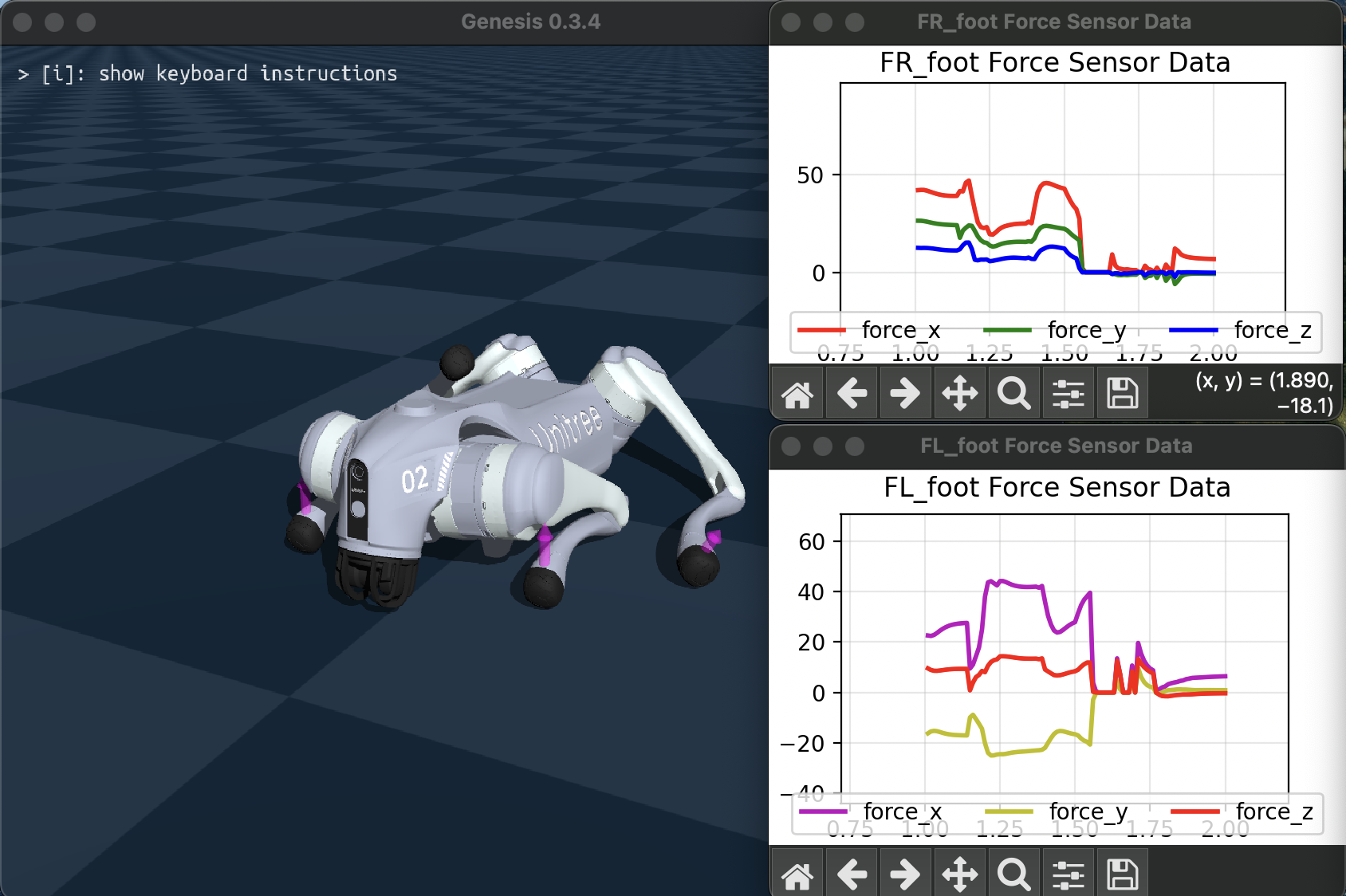
KinematicContactProbe#
KinematicContactProbe 是一种触觉传感器,会在连接到刚体连杆的用户自定义探针位置采样接触深度。它不会直接返回求解器接触力,而是基于穿透深度估算每个探针的力:这是一个三维向量,大小为 stiffness * penetration,方向由探针法线决定:
force = stiffness * penetration * normal
probe = scene.add_sensor(
    gs.sensors.KinematicContactProbe(
        entity_idx=platform.idx,
        link_idx_local=0,
        probe_local_pos=probe_positions,
        probe_local_normal=probe_normals,
        probe_radius=probe_radii,
        stiffness=5000.0,
        draw_debug=True,
    )
)

scene.build()

data = probe.read()
print(data.penetration)  # shape ([n_envs,] n_probes)
print(data.force)        # shape ([n_envs,] n_probes, 3)
完整交互示例位于 examples/sensors/kinematic_contact_probe.py。
由于探针在连杆局部坐标系中定义,可以用规则网格来模拟触觉表面上的触觉像素。
ElastomerDisplacement#
ElastomerDisplacement 可以在不实际仿真形变的情况下建模柔性触觉皮肤。每个探针都会报告由局部压入、剪切和扭转引起的三维位移向量。
可以通过以下系数调节传感器响应。空间影响按 exp(-coeff * dist^2) 计算,系数越大影响越局部,系数越小传播越远:
dilate_coefficient- 法向压入的扩散范围。shear_coefficient- 切向滑移的扩散范围。twist_coefficient- 扭转位移的扩散范围。
tactile = scene.add_sensor(
    gs.sensors.ElastomerDisplacement(
        entity_idx=pusher.idx,
        link_idx_local=0,
        probe_local_pos=gu.generate_grid_points_on_plane(
            lo=[-0.05, -0.05, -0.025],
            hi=[0.05, 0.05, -0.025],
            normal=(0.0, 0.0, -1.0),
            nx=6,
            ny=8,
        ),
        probe_local_normal=(0.0, 0.0, -1.0),
        probe_radius=0.01,
        dilate_coefficient=1e1,
        shear_coefficient=1e-2,
        twist_coefficient=1e-2,
        draw_debug=True,
    )
)

scene.build()

displacement = tactile.read()
print(displacement)  # shape ([n_envs,] n_probes, 3)
当 probe_local_pos 以二维网格形式提供时,Genesis 会使用基于 FFT 的算法来加速较大触觉阵列的计算。
示例脚本 examples/sensors/tactile_elastomer_sandbox.py 展示了球形或盒形推动器与其他物体的交互。
另一个示例脚本 examples/sensors/tactile_elastomer_franka.py 会在机械臂夹爪手指上布置网格触觉像素。